what is freediving?

Freediving is more than a sport, it’s a lifestyle. Whether it’s recreational freediving, spearfishing and competition/sport diving, freediving is the art of submerging beneath the surface of the water on a breath hold.
A moving meditation, it requires focus and total presence. In order to progress, we train a combination of mental resilience, technical skills and self-awareness.
Freediving is for anyone with a decent level of fitness, who is able to swim unassisted.
By training our mind and body, we can optimise relaxation for successful dives.
one breath
There are several disciplines.
In open water, and in the pool.
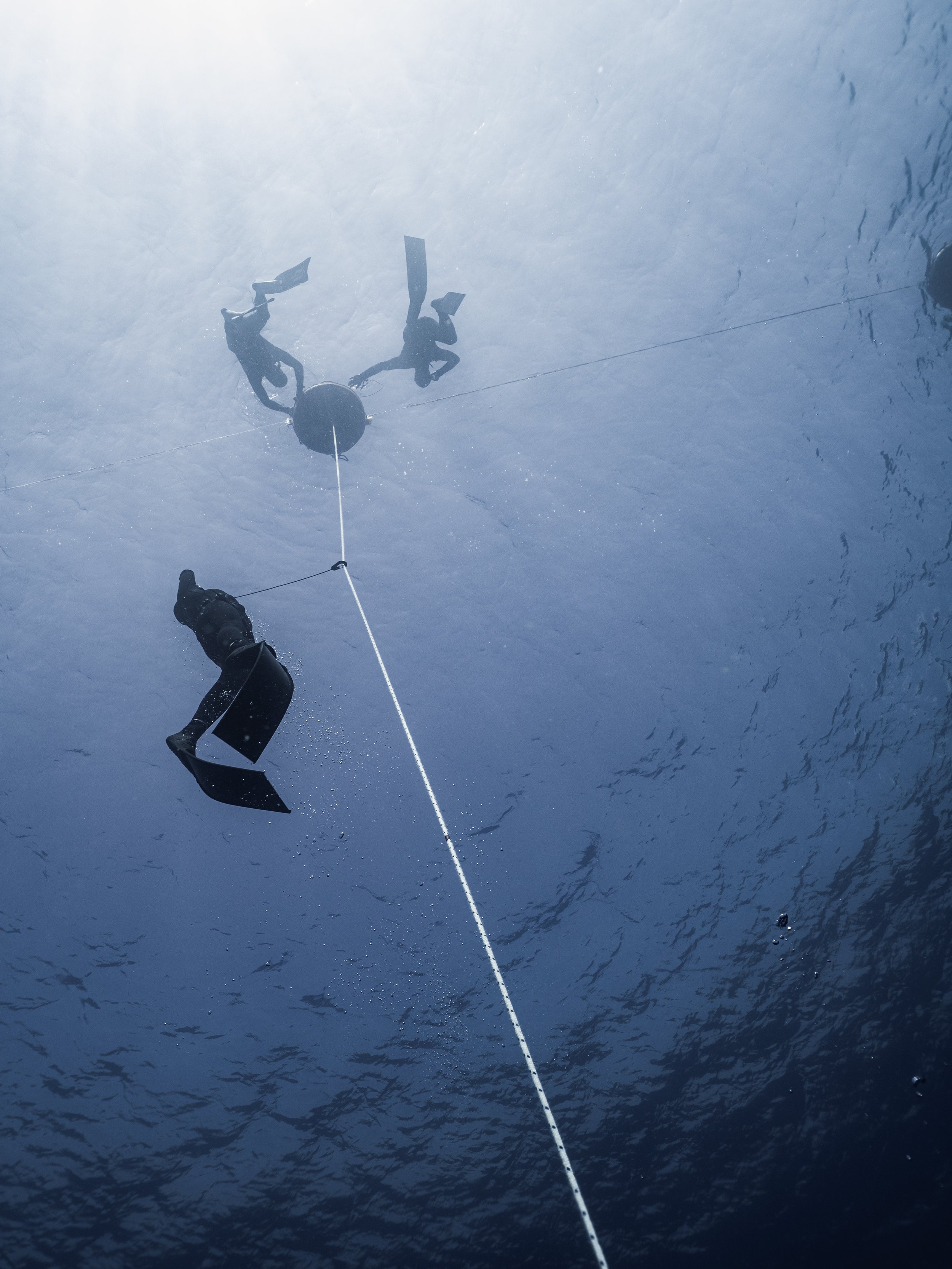
Free Immersion (FIM)
This discipline sees a freediver descend and ascend to depth by pulling along a vertical rope, without the use of fins to propel them.
Constant Weight (CWT)
Using fins or a monofin, this is the most common discipline for recreational and competitive freediving. The freediver wears weights to descend and may not drop them to ascend.

Constant Weight, No Fins (CNF)
Considered the most challenging discipline, here a freediver must descend and ascend without any equipment, using a modified breaststroke technique.
Dynamic Apnea (DYN)
Measured in distance rather than depth, in DYN a freediver is weighted to midwater, and using bi-fins (DYNB) or monofin (DYN).
Dynamic No Fins (DNF)
The most physically demanding of the pool disciplines, DNF is distance without fins.
Variable Weight (VWT)
Less common and not included in competition diving, in this discipline freedivers descend on a weighted sled or cable, and pull or swim back up.
Static Apnea (STA)
This is a static measure of breathhold time, and is a stationary dive, testing mental strength and relaxation.
No Limits (NLT)
Again, freedivers use a weighted sled to descend and a balloon to ascend using a lift bag. It’s considered risky.